

Revisiting a 50-year-old question with modern data science
1. Introduction
Can we fight wildfires before they start or find out their trigger or inception point? As droughts intensify and lightning ignitions increase across the western US and Canada. Cloud seeding has been proposed as a possible mitigation tool. The hypothesis: inject a radar inhibiting substance known as ‘chaff’; into clouds, reduce the electrical conductivity of the storm cloud, and perhaps disrupt the lightning capability that could potentially spark wildfires.
But does it actually work?
This post outlines a research framework for testing whether cloud seeding measurably suppresses lightning activity. The approach draws inspiration from Kasemir’s 1976 paper on cloud electrification, which first described how modifying cloud properties might alter the electrical structure of storm clouds. Today, satellite observations, lightning detection networks, and open weather models allow us to revisit Kasemir’s hypothesis with modern analytical precision.
1.1 Revisiting Kasemir (1976): Theoretical Basis
Kasemir’s research proposed a hypothesis: Can cloud seeding alter storms electrical field and move it below a threshold to prevent lightning altogether?
His approach centered on modifying the storm’s electrical field. When electric field strength near the cloud base exceeded a defined threshold (~50 kV/m), Kasemir released conductive chaff fibers tiny aluminum-coated strands into the charged region. The fibers produced localized ion currents and increased air conductivity, allowing accumulated charge to dissipate before reaching lightning-triggering levels.
The work provided a causal framework to conduct atmospheric field experiments:
- Identify the onset condition (electric field threshold).
- Introduce a measurable perturbation (chaff release).
- Track field evolution and lightning frequency relative to unseeded controls storms.
Kasemir’s insight was conceptual, limited by the sparse observations of the 1970s. Yet it laid a foundation for today’s key question:
Can measurable lightning suppression be detected in seeded storms compared to unseeded ones under similar meteorological conditions?
This work would showcase some of results conducted during a field experiment across western Canada in the summer of 2024.
2. Methodology
The field trials were conducted over a period of Aug-Sep 2024 over Alberta, during the summer season. Eight storms were seeded with chaff based on the developing weather conditions that day.
This study follows a Before After Control Impact (BACI) design: we assess lightning distribution between Seeded and Control Storm cells, before and after the release of Chaff into the storm clouds. Each distribution is tested with a Mann-Whitney U test to check whether chaff produced a statistically significant shift in lightning activity.
What this trial actually used.
- Lightning activity: Canadian Lightning Detection Network (CLDN).
- Storm structure: MRMS radar reflectivity, tracked as a moving centroid/polygon.
- Seeding activity: flight logs, GPS position at release.
- Atmospheric fields: HRRR and ERA5.
In this analysis, roughly 65,000 raw CLDN strikes across 9 storm days were analyzed by using the Canadian Lightning detection network data. The storm clouds were tracked by MRMS radar graphs and it’s precipitation intensity.
2.1 Building the test
We developed a spatio-temporal tracking statistical framework to assess the behavior of seeded vs control storm clouds. For each of the eight storms, the pipeline:
- Logs the release: chaff-release time and GPS, pulled from flight logs.
- Tracks the storm from radar, frame by frame: radar imagery captured every 6 minutes was used to delineate each storm and control cell as a polygon: the zone of high-reflectivity return being the constrained region. That polygon was based on reflectivity zones which shifted during each dynamic temporal reflectivity image snapshot.
- Counts strikes inside the tracked polygon: For each unique radar graph the lightning strikes were aggregated that were contained within the reflectivity polygon zone.
- Identify a control storm: a nearby, unseeded storm cell, identified and tracked the same polygon-by-polygon way, run through the identical test and assessed during the similar time window.
- Tests the difference: Mann-Whitney U, seeded storm against its own pre-period and against the control.
2.2 Statistical Evaluation Framework
The Mann–Whitney U test provides the statistical framework for this experiment. The null hypothesis assumes that seeding has no effect on lightning frequency, such that the seeded and non-seeded cells come from populations with similar distributions of lightning frequency. A statistically significant decrease in lightning frequency in the seeded cells relative to the non-seeded control cells would provide evidence against the null hypothesis, leading us to reject it.
- Null Hypothesis (H₀): Seeding has no effect on lightning frequency.
- Alternative (H₁): Lightning frequency decreases post-seeding.
For the analysis, we evaluated the data using the following metrics such as lightning density and flashrate in a spatial zone.
Metrics
- ΔLightningDensity = (Post – Pre) / Pre
- ΔFlashRate per cell (flashes min⁻¹)
- Spatial shift between reflectivity maxima and lightning centroid
3. Results
Overall, we assessed about 8 storms in this data, out of 4 storm cells (P1/3/6/8) were chosen for statistical analysis. The remaining cells either large variability and uncertainty whether chaff was ingested in the atmosphere. We estimated that using radar reflectivity graphs to estimate estimate and point and time of chaff ingestion.
3.1 What Actually Happened, Pre vs. Post Seeding
We use the Mann–Whitney U test, a non-parametric test for comparing the distributions of two independent groups, to assess whether lightning activity differs between seeded and control cells.
The analysis is structured around the timing of seeding. For each 5-minute interval relative to chaff release, we compare lightning activity in the seeded cells with that in the corresponding control cells. This allows us to examine whether any difference emerges after seeding that was not already present before treatment.
Pre-seeding period. The intervals before release provide a baseline for assessing whether the seeded and control groups exhibit similar lightning activity prior to treatment. A statistically significant difference during this period would indicate that the groups were already different, complicating the interpretation of any subsequent post-seeding difference. However, a non-significant result should not be interpreted as proof that the groups are identical; it indicates only that the analysis did not detect a statistically significant difference.
Post-seeding period. We apply the same comparison to the intervals following release. If seeding reduced lightning activity, we would expect the seeded cells to exhibit lower lightning activity than their controls, potentially reflected in statistically significant differences and a consistent negative effect across post-seeding intervals.
The hypotheses for the distributional comparison are:
- H₀: The distribution of lightning activity is the same in seeded and control cells.
- H₁: The distributions of lightning activity differ between seeded and control cells.
Observed result. The pooled analysis across P1, P3, P6, and P8 does not show statistically significant differences at any of the examined 5-minute intervals. The smallest observed p-value occurs at +3 minutes after release (p = 0.18), which remains above the pre-specified significance threshold of 0.05. The post-seeding intervals therefore do not provide statistically significant evidence of a reduction in lightning activity in the seeded cells relative to the controls.
In this analysis, the first condition is broadly consistent with the results, but the post-seeding significance and consistent reduction required to support a detectable seeding effect are not observed. The results therefore do not provide statistically significant evidence that chaff release reduced lightning activity during the analyzed post-seeding window.
4. Discussion
4.1 Why This Is Harder Than It Looks
Even with modern lightning networks and radar, distinguishing a seeding effect from ordinary storm variability is genuinely difficult. The results from our experiment showed that seeding did not have a statistically significant variation in seeded vs control storm cells. The following are some reason why we think this strategy wasn’t effective.
Storm evolution: Convective cells merge, split, or decay within minutes. Storms are chaotic and change rapidly within a short time period. The chaff seeding would likely be effective when deployed during the inception of a storm surge stage.The precise window, can be inferred by short term forecasting weather models.
Deployment timing and location: Storms are chaotic systems whose electrical structure develops fast, a cell’s updraft and charge separation can organize, peak, and start to weaken within a single 20–60 minute lifecycle. This trial released chaff at a distance in the vicinity of the storm. Seed too early, or too late, the seeding would effectively would not have any change as observed in our results. The ideal target is deployment right at a storm’s inception and finding that precise window is challenging.
Chaff amount: Chaff deployment and release relied on it being ingested by the storm’s updraft. However, dosage and location of storm being targeted spanning an area as vast as 20 km² area might only show minimal lightning region in that micro zone. chaff ingested into only a small portion of it may not affect meteorological variables elsewhere in the storm. That’s the core difficulty more regions likely need to be targeted, with monitored control cells for each.
Chaff ingestion into storm cell P1
Small sample size. Only four storm cells were deemed suitable for analysis, leaving too small a sample to draw firm conclusions from. Another season of field acquisition and experimentation would provide much greater clarity on whether this strategy is effective.
6. Conclusion
In this study, we trialed chaff-based cloud seeding as a method to suppress lightning. Although, the experiment didn’t show significant effect, it may have been down to logistical and meteorological challenges. It is important to test methods and ways to suppress the effect of wildfires impact given the impending climate situation.
Lightning is only one of several forces behind wildfire ignition and spread. Dry lightning accounts for a large share of remote, hard-to-suppress ignitions, but human activity, power lines, equipment, campfires, arson starts the majority of fires in populated regions, and once a fire is burning, its spread is driven far more by fuel load, drought-driven fuel moisture, and wind than by anything upstream in the storm that started it. A cloud-seeding program, even a fully proven one, would only ever address the ignition side of one ignition pathway; it wouldn’t touch fuel management, or human induced ignition, which make up most of the problem.
References
- Kasemir, H. W., Holitza, F. J., Cobb, W. E., & Rust, W. D. (1976). Lightning suppression by chaff seeding at the base of thunderstorms. Journal of Geophysical Research, 81(12), 1965–1970.
- Bruintjes, R. T. (1999). A review of cloud seeding experiments to enhance precipitation and some new prospects. Bulletin of the American Meteorological Society, 80(5), 805–820.
- Tessendorf, S. A., et al. (2012). The Cloud-Aerosol-Precipitation Experiment (CAPE): Overview and preliminary results. Bulletin of the AMS, 93(12), 1911–1929.
- Silverman, B. A. (2003). A critical assessment of glaciogenic seeding of convective clouds for rainfall enhancement. Bulletin of the AMS, 84(9), 1219–1230.
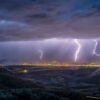
- Intro photo: Frank Cone, Pexels.





Follow Me